Big Brown Bats:
Big brown bats can be found in a number of rural, urban and suburban habitats, and roost in tree hollows, under rocky ledges and in a number of man-made structures. Little brown bats live in similar habitats, but will also roost in caves, mine tunnels and wood piles.
Little Brown Bats:
The little brown bat lives along streams and lakes. It forms nursery colonies in buildings. In the winter it hibernates in caves and mines.
Showing posts with label Brown. Show all posts
Showing posts with label Brown. Show all posts
Friday, May 28, 2010

Little Brown Bats Diet
Little brown bats are insectivores, eating moths, wasps, beetles, gnats, mosquitoes, midges and mayflies, among others. Since many of their preferred meals are insects with an aquatic life stage, such as mosquitoes, they prefer to roost near water. They echolocate to find their prey. Often they will catch larger prey with a wingtip, transfer it to a cup formed by their tail, then eat it - smaller prey are usually just caught in the mouth. They often use the same routes over and over again every night, flying 3-6 meters high above water or among trees. An adult can sometimes fill its stomach in 15 minutes; young have more difficulty. If they do not catch any food, they will enter a torpor similar to hibernation that day, awakening at night to hunt again.
(Info From: http://en.wikipedia.org/wiki/Little_brown_bat#Diet)
(Info From: http://en.wikipedia.org/wiki/Little_brown_bat#Diet)
A Big Brown Bats Diet
Big brown bats are insectivorous, eating many kinds of night-flying insects including mosquitoes, moths, beetles, and wasps which they capture in flight. This causes the sudden, frequent changes in direction.
(Info From: http://en.wikipedia.org/wiki/Big_brown_bat#Diet)
(Info From: http://en.wikipedia.org/wiki/Big_brown_bat#Diet)
Differences Between Big Brown Bats and Little Brown Bats
Want to know the differences between Big Brown Bats and Little Brown Bats? Here they are:
Little Brown Bat (Myotis lucifugus)
Forearm — 1.34 to 1.61 inches (3.4 to 4.1 cm)
Wingspan — 9.02 to 10.59 inches (22.9 to 26.9 cm)
Ears — 0.55 to 0.63 inches (1.4 to 1.6 cm)
Foot — approximately 0.39 inches (1.0 cm); long hairs on toes extend beyond claws.
Color — Pale tan through reddish brown to dark brown, depending on geographic location. The species is a rich dark brown in the eastern United States and most of the West Coast. Fur is glossy and sleek.
Big Brown Bat (Eptesicus fuscus)
Forearm — 1.65 to 2.01 inches (4.2 to 5.1 cm)
Wingspan — 12.80 to 13.78 inches (32.5 to 35.0 cm)
Ears — with rounded tragus
Color — From reddish brown, copper colored, to a dark brown depending on geographic location. This is a large bat without distinctive markings.
See the differences?
Little Brown Bat (Myotis lucifugus)
Forearm — 1.34 to 1.61 inches (3.4 to 4.1 cm)
Wingspan — 9.02 to 10.59 inches (22.9 to 26.9 cm)
Ears — 0.55 to 0.63 inches (1.4 to 1.6 cm)
Foot — approximately 0.39 inches (1.0 cm); long hairs on toes extend beyond claws.
Color — Pale tan through reddish brown to dark brown, depending on geographic location. The species is a rich dark brown in the eastern United States and most of the West Coast. Fur is glossy and sleek.
Big Brown Bat (Eptesicus fuscus)
Forearm — 1.65 to 2.01 inches (4.2 to 5.1 cm)
Wingspan — 12.80 to 13.78 inches (32.5 to 35.0 cm)
Ears — with rounded tragus
Color — From reddish brown, copper colored, to a dark brown depending on geographic location. This is a large bat without distinctive markings.
See the differences?
Friday, May 7, 2010
Little Brown Bats
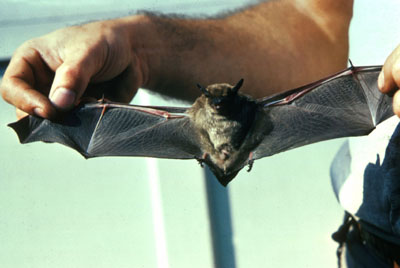 Little Brown Bats:
In summer the little brown bat inhabits trees, bat houses, and buildings, usually choosing a hot attic, where nursery colonies of hundreds and even thousands form. Less frequently colonies form beneath tar paper, siding, shingles, or other similar sheltered spots,. In the west colonies have been found beneath bridges and in caves. Single males have been found in attics, behind shutters under bark, in rock crevices, behind siding and under shingles. Groups of males occasionally occur in caves.
In a summer colony the bats remain alert on warm days. In any large group a few are usually active, crawling about over the others and bickering. A colony can be heard as far away as 100 feet. Toward evening the bats become more active until a constant squeaking can be heard as they gather about the exits. They begin to emerge at late dusk. When there is water nearby, most of the bats head at once for the water where they begin feeding a few feet above the surface as they continue to disperse.
(Visit Web-page)
Friday, April 30, 2010
Big Brown Bats
Big Brown Bats are the most common species of bats in Massachutes. You would typically find colonies of Big Brown Bats in attics that range from 2-200 bats.
Link to page: http://www.batguys.com/services/bats/Bat-Article.html
Link to page: http://www.batguys.com/services/bats/Bat-Article.html
Subscribe to:
Posts (Atom)